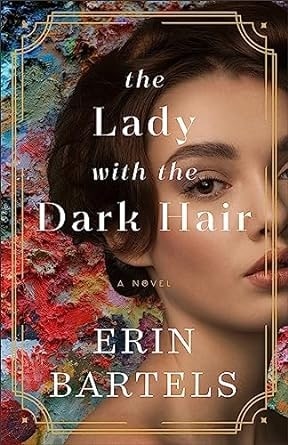
The Lady With the Dark Hair, reviewed by Susan Latreille
In the past, I’ve reviewed fiction related in some way to art or artistic endeavours.
This time I’m reviewing fiction as usual, but it will be followed up in my next review by a non-fiction inspired by the reading of this novel. As I read The Lady with the Dark Hair (2024) by Erin Bartels, I kept running to Google with questions. So, I decided to search for a non-fiction book that would maybe give me some answers and, at the same time, be entertaining. You’ll find out about that second book in my next review and maybe get some answers too.
I read The Lady with the Dark Hair almost a year ago so here’s hoping I do it justice with this review. The novel has a strong focus on painting as an art both historically and in present day, and this aspect is well portrayed with a dual-timeline premise. That timeline also intertwines the lives of two women connected by art and family secrets. Even if you don’t like dual timelines, give this novel a try as the author makes it easy to follow with the beginning of each chapter telling the reader exactly when and where they are.
In the present day, Esther Markstrom owns and manages a small museum/art gallery in Michigan dedicated to her ancestor, painter Francisco Vella. Although the museum houses many paintings and sketches by Vella, what is considered his masterpiece, a portrait titled “The Lady with the Dark Hair”, hangs over the mantle in Esther’s home. However, the provenance of that ‘masterpiece’ becomes questionable when Esther’s former art history professor raises some doubts about the painting. She soon realizes, that if her mentor is correct, it could mean her entire family legacy is built on a lie. These doubts and questions lead Esther on a journey to uncover the truth, a journey from her small hometown to Spain and France and Gibraltar where she delves into archives, interviews art historians, uncovers forgotten records, and pieces together a story that challenges what she (and her family) has long believed and cherished about Vella and his works.
Esther’s journey is not just about art—it becomes a personal odyssey as she grapples with her feelings of inadequacy, questioning her value beyond the shadow of her illustrious ancestor.
The historical narrative is set in the late 19th century, and we follow the life of Viviana Torrens, a Catalan fugitive who finds refuge in Southern France. There, she meets Francisco Vella, a colourman and merchant dealing in artists’ pigments. NB—this is where I started running to Google to find out about colourmen and the origins of the colours so valued by artists the world over.
As a fugitive, Viviana’s life is in danger and to evade capture, deportation and worse, she poses as Vella’s sister, accompanying him on his travels across Europe. In this new life, Viviana strives to develop her artistic talents, but as a woman, she faces significant obstacles in pursuing art as a career. In her pursuit, she encounters some of the few and famous (or infamous) women artists of that time, and that makes for some interesting reading.
Viviana’s artistic style matures, becoming bolder and innovative. But her work remains virtually unsigned and unacknowledged, hidden behind Francisco’s name. Viviana’s struggle for independence and recognition as an artist takes her on voyages well beyond Vella’s merchant territories.
This story is fiction with much fact behind it, including cameo appearances by female artists such as Mary Cassatt and Berthe Morisot. A quote from the author points to the wealth of factual information to be found in this novel: “I did a lot of research into the lives of female artists, the Impressionist movement in art, the origin of the colors and pigments artists have used over the millennia, schizophrenia, and the histories of three political crossroads: Gibraltar, Catalonia, and Alsace-Lorraine”. This is substantiated by a list of more than twenty titles in Books for Further Reading.
The Lady with the Dark Hair brings to life the challenges faced by women artists in the 19th century, women’s roles in history and how those roles were so easily erased, artistic integrity of the past and the present, as well as the complexities of uncovering family histories in the present day. This novel is beautifully written; filled with vivid detail and description, and I highly recommend it as an enjoyable and informative read. It is available from the SDG Library in eBook format and from Amazon or Chapters/Indigo in various formats.
 Collectif
Thank you, Susan, for sharing your passion for reading and for the art, the artists and their journeys. This is a fascinating story. I’m looking forward to reading the Lady with the dark hair.
LikeLike
[…] Museum workshop in July of 2024. When I read The Lady with the Dark Hair (reviewed here 13 February 2025), I had lots of questions. Still, they were rather general queries about colourists and the […]
LikeLike