Reviewed by Jessica MacLeod
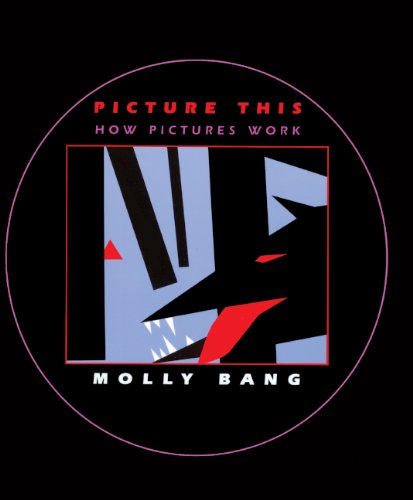
Picture This: How Pictures Work by Molly Bang (Chronicle Books, 2000) is a great book for gaining a better understanding of how the structure, elements, and artistic principles of a picture influence viewers’ emotional responses. It can change how you look at art and challenge you to think differently about your own creative practice.
While books with this aim are certainly not new or rare, Picture This stands out. It is quick to read (the 2000 edition is only 96 pages) and easy to understand yet thorough. It is comforting in its sincere and patient look at art and our responses to it. It’s a book you’ll likely reach for again.
The book’s author, Molly Bang had already been making a living as a writer and illustrator of children’s books when she realized, and admitted to a friend, that she didn’t fully understand how pictures work. To learn more, she did what most of us would: took a painting class, read more, talked to others, and visited galleries and museums. But her real learning began when she decided to teach pictures to her daughter’s third grade class. She began cutting up and playing around with pieces of coloured construction paper. These experiments and observations are the basis of Picture This.
Using just four colours of construction paper and a pair of scissors, Bang tackled some images about Little Red Riding Hood, a story almost any reader would already know. But wait, don’t walk away. Picture This isn’t a children’s book. It’s entirely appropriate for adults and young adults because of how complex the analytical and creative process can be. Patient and creative adults will appreciate the multiple creative decisions that influence a work.
Almost every page has a simple but striking image to accompany the text. And the explanations help us linger over the images longer than we would otherwise. She includes an image in which Little Red Riding Hood is represented by a small red triangle. The wolf’s squinting eye and big tongue are also red. She admits, “I see here, in a way I didn’t understand before, that when two or more objects in a picture have the same colour, we associate them with each other” (p. 36). I like that she shares what she was thinking as she learned.
Over the course of the book, Bang talks us through distance, depth, cohesion, emphasis. We learn how a shape’s size, orientation, colour, and placement affect the viewer’s feelings. Bang also explains, “Our feelings arise because we see pictures as extensions of the real world. Pictures that affect us strongly use structural principles based on the way we have to act in the world in order to survive. As soon as you understand these principles, you will understand why pictures have such specific emotional effects. You will understand how pictures work” (p. 41). We realize what is a comforting versus threatening shape. We learn why our eyes are pulled to certain objects or areas of the composition. Reading this book helps us get pictures.
Picture This is good for artists, illustrators, photographers, and even those looking to enhance their viewing experiences of art. It can encourage artists who are willing to step away from their usual approaches. Sometimes we may feel obliged to convey realism at the expense of feeling. Sometimes we’re so eager to just get a work going and done that we don’t consider more creative possibilities for our ideas. Sometimes we need to start with the feeling we want the viewer to have and then go from there. I know I’d like to work that consideration into earlier stages of my own creative process.
Bang recommends that readers take up their scissors and construction paper to try similar experiments, and she provides helpful instructions and exercises to get started. In fact, “This is just the beginning” are her closing but encouraging words.
Not available in our library system. Available on Abe Books (used) and Amazon. Also Picture This: How Pictures Work Revised and Expanded 25th Anniversary Edition.
 Collectif
Thanks for the suggestion. I’ve checked it on line and a lot of people like this book.
Ruth
>
LikeLike
Including me, Ruth! I got to read the review early, procured and rsad it. Fabulous explanations/demonstrations of how we “read” pictures. It is also very beautifully presented. Ed
LikeLike
Great review, Jessica. Not just that you liked it but great job describing the content. Now I want this book.
LikeLike
Thank you so much, Jessica for this insightful read and the practical aspects we can expect from Picture this. Your analysis definitely will make me think twice about my own structure.
LikeLike