Reviewed by Jessica MacLeod
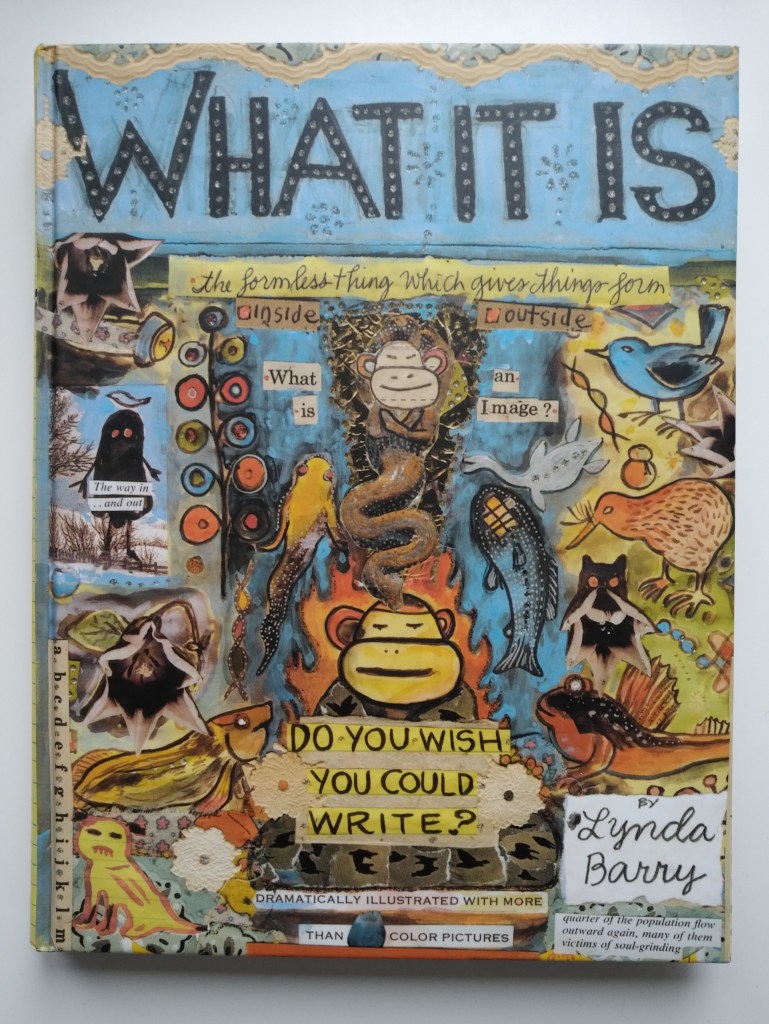
Lynda Barry’s What It Is (2008, Drawn and Quarterly) may be a strange experience for you. When you pick this book up, instead of saying the name of the book silently as you read its title, you’re more likely to whisper “What is this?” That’s what I did.
Flipping through, you’ll quickly discover what this 210-page, full-colour visual extravaganza is not.
It is not typical, so toss your expectations. It is not tidy. Some pages have too much to take in at once. Sometimes, you may not even know where to start on the page.
It is not quick. If you’re striving for that annual reading goal, don’t use this book. Instead, savour, sample, see what inspires you, and sit your butt down for the work (and play). Spend days instead of hours.
It is not definitive. What It Is raises more questions than it answers—but that can be good for you.
If you still want to know more, pat yourself on the back for your adventurous spirit and read on.
Part memoir and part how-to book for those seeking creative play in writing and art, What It Is is also a work of visual art and winner of the comic industry’s 2009 Eisner Award for Best Reality-Based Work.
In this book, Barry presents a colourful mix of collage, watercolour, drawing, and handwriting to present memories, questions, prompts, and exercises that will comfort and inspire both writers and artists. Every page is unique and worth exploring. Readers will notice not just text but also bits that are cut or torn and then pasted in, brush and ink drawings, careful hand lettering, as well as the many patterns, motifs, and decorative flourishes and borders.
In moving, relatable images, she presents childhood memories, awkward moments, and struggles for self and understanding. She recalls how books gave her lived experiences that the outside world did not. She draws and writes of her child self: red-headed, freckled, feeling alone, and taking comfort in the images of books, TV, and drawing.
While art and writing had been her escapes and her tonic, they were still frustrating. She recalls that some days she could draw well and then other times she would erase and erase until the paper wore through. She remembers when her peers began to stand out for their talents, and how her waves of hopelessness would rise and fall with those times.
Barry also admits that at some point, two questions began to take over her thinking when she was writing or drawing: “Is this good?” and “Does this suck?” These questions are heavy anchors for the creative soul. I know those questions well myself. How do we toss those anchors and attempt a more playful creative journey?
Barry believes the answer is less thinking and more action, and she provides exercises to help.
Part of What It Is is presented like an activity book with instructions and examples for tapping into your creative powers. All you need is some cheap, lined, and hole-punched paper that you can keep in a binder. Then, find a timer or two and a pen that you like for writing and doodling. The first task she has for you needs just three minutes. Although other exercises take longer, if you have been following her process, you are happy to find the time at some point in your week.
She makes the tasks easy and fun. You’re not diving into paragraphs or a linear, thoughtful explanation of certain facts or feelings. No, we’re talking fast lists of images–whatever bubbles up quickly if you don’t think too much. Then we’re looking around within an image or prompt for what is alive, and asking questions to poke around some more. Another exercise is to make a picture bag. This involves gathering at least 25 pictures from old magazines, newspapers, or books. Ideally, you are finding unfamiliar scenes as opposed to objects in isolation.
You do need to be patient and a bit courageous if you are going ahead with the What It Is experience. Accept that you may feel a bit lost as you begin this type of play. I think many of us are scared of losing our heavy anchors and floating off into the unpredictable. You may worry, “How will this turn out? What am I stirring up from the depths? Am I wasting my time? What do these images say about me?”
Instead of being mired in those questions and doubts, can you instead look elsewhere to drift onward through images? What It Is will hopefully help you do that.
I admire Barry for the time, care, and creativity she put into this book. With patience, courage, and acceptance, she has sat with her thoughts, feelings, and experiences enough to get to know them better, has learned from and adorned them, and then shared and cared for them like a gentle soul would cup a small chick in both hands to carefully show others.
Lynda Barry is a cartoonist, graphic novelist, and educator at the University of Wisconsin–Madison. In addition to What It Is, she has also written three other books about the creative process. What It Is and some of Barry’s other works will hopefully be in the SD&G Library’s catalogue someday. In the meantime, you can find them at betterworldbooks.com and indigo.ca

 Collectif
It looks like a mind running riot. If we could get our minds to run so freely what wonders could we create?
LikeLiked by 1 person
That book looks fascinating, frustrating, and compelling! Thanks for writing about a book I probably wouldn’t have picked up without first knowing something about it. I want to add that the Cornwall Public Library has this book, as well as some others by Lynda Barry—for those who have a membership there.
LikeLike
Thank you, Jessica, for this wonderful take on such an unusual book about writing. You really enticed me to look for it. It also inspires me to add more writing to my upcoming exhibition at the library in December. Will I succeed?
LikeLike